


Amendment to Slovakia’s Residence Permit Law of June 2, 2026: What Has Changed for Foreigners
In June 2026, Slovakia enacted Act No. 128/2026 Z. z., which amended the Act on the Residence of Foreigners and several related laws. The amendment to the Act on Residence Permits was adopted on June 2 and published on June 18, 2026, but not all provisions take effect at the same time. The majority of the changes take effect on July 15, 2026.
For foreigners, it means new rules regarding national visas, residence permits, employment, business residence permits, and the transition from temporary protection to other grounds for residence. It is important not to view the reform as a single, universal change: the implications depend on your specific grounds for a residence permit in Slovakia and the date it was issued.
Act No. 128/2026 Z. z.: Dates to Know
Formally, it amends not only Act No. 404/2011 Z. z. on the Residence of Foreigners, but also provisions regarding citizenship, citizen registration, and employment services. For those interested specifically in the changes affecting foreigners in Slovakia in 2026, the most important provisions concern national visas, temporary residence, documentation, employment, and transitional rules.
| Event | Date |
| Enactment of Act No. 128/2026 Z. z. | June 2, 2026 |
| Publication | June 18, 2026 |
| Entry into force of the main provisions of the amendment | July 15, 2026 |
| Entry into force of the provision on the digital stay document | October 1, 2026 |
| Entry into force of a separate provision related to ETIAS | On the day ETIAS launches |
Below, you'll find more about which changes may be important in practice.
120-day national visa: It does not apply to all applicants
One of the most notable changes is that the validity period of national visas issued to obtain a residence permit that has already been approved or to apply for one in Slovakia has been extended to 120 days.
Simply put, this refers to situations in which a person needs a national visa because they have already been granted a residence permit in Slovakia or need a visa to apply for a residence permit under Act No. 404/2011 Z. z.
However, this does not mean that all national visas are now valid for four months. The law contains separate rules for temporary stays and other grounds, so each case must be reviewed individually.
It is also important not to confuse the visa’s validity period with the processing time for a residence permit application: 120 days do not mean automatic approval or an expedited immigration process.
Is it necessary to apply for a national visa in person?
Another change concerns the submission of applications for a national visa. As a general rule, an applicant must submit documents in person at a Slovak diplomatic mission abroad, unless the law provides for an exception.
In certain cases, in-person submission may not be required. However, this is not an automatic right of the applicant: such an exception is possible only by decision of the Slovak Ministry of Foreign Affairs and in consultation with the Ministry of the Interior, provided there are special reasons for doing so.
Digital stay permit: What will change from October 1
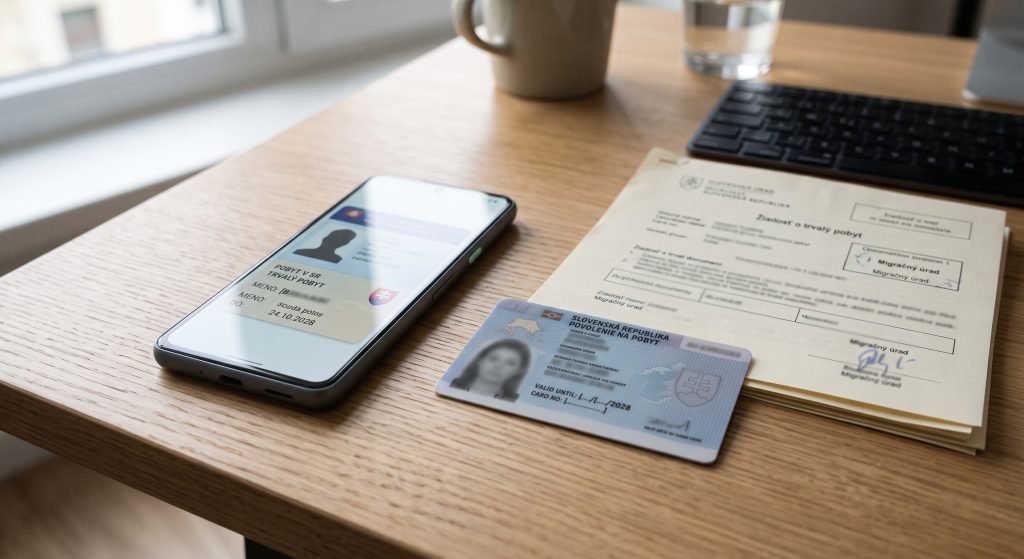
This image was created using AI
From October 1, 2026, a digital residence permit - the Digitálny doklad o pobyte - is set to be introduced in Slovakia. This is not a new category of residence permit, but rather a digital version of the residence permit, the rules for which are set forth in the new regulation.
A foreign national will be able to create a digital copy of their document only through a mobile app administered by the Slovak Ministry of the Interior (v správe ministerstva vnútra).
If the inspecting authority has the necessary app and the technical requirements are met, presenting a digital document has the same legal effect as presenting a physical residence document.
However, the law explicitly sets forth important restrictions: a digital document cannot be used for border control. It also cannot be presented in proceedings under Act No. 404/2011 Z. z. on the Residence of Foreigners. Consequently, the digital version does not replace the physical card.
For travel, border crossings, and immigration procedures, the physical document must still be kept and presented when required.
Single Residence and Work Permit
The amendment also applies to foreign nationals whose residence permits in Slovakia are work-related. In such cases, it is important to verify not only immigration documents but also the terms of employment: the job opening, the employer, and confirmations from the relevant authorities.
Immigration matters are handled by the Ministry of the Interior and the Foreigners’ Police Department (Oddelenie cudzineckej polície). Job openings and employment matters are handled by the Office of Labor, Social Affairs, and Family (Úrad práce, sociálnych vecí a rodiny).
The most important thing for an employee is this: if they lose their job or find a new one after a period of unemployment, they must report this to the immigration police within 7 business days. This is not just a formality. It is not enough to simply find a new employer - it is important to notify the police on time of the start and end of the period of unemployment.
However, unemployment in and of itself does not automatically result in the revocation of a residence permit. The consequences depend on the basis for residence, the duration of unemployment, and other legal requirements.
This is also an important consideration for employers: before hiring a foreign worker, they should verify what documentation is required for the specific position and hiring process.

This image was created using AI
Business residence permits and debts: What has changed
If you hold a business residence permit in Slovakia, you should read this section particularly carefully: the amendment clarifies the rules regarding an entrepreneur’s outstanding debts.
This isn't just about taxes. You need to check for outstanding debts owed to the tax authority, customs, and social security, as well as overdue claims from health insurance companies - pohľadávky po splatnosti.
It is important to note that the review may not be limited to the foreign national as an individual. Under § 111(10), relevant debts of companies and cooperatives on whose behalf the entrepreneur acts are also taken into account. Therefore, if a person owns several companies or operates through various entities, it is advisable to review each of them.
However, this rule should not be interpreted to mean that “any debt automatically leads to the revocation of a residence permit.” There is a legally established procedure and specific grounds for revoking a temporary residence permit. Factors such as the nature of the debt, its connection to business activities, information from the competent authorities, and transitional provisions are all taken into account.
The procedure for revoking a business residence permit due to outstanding debts applies to arrears arising under the rules effective as of July 15, 2026. However, this does not mean that any old debts can be ignored in all cases: the situation must be assessed based on the specific circumstances.
If you are already running a business in Slovakia, it is a good idea to separately check for any outstanding debts through Finančná správa SR, Sociálna poisťovňa, and your zdravotná poisťovňa.
Ukrainians with temporary protection: Transition to other grounds
A separate section of the amendment is devoted to people who are granted temporary protection - dočasné útočisko in Slovakia. § 131o establishes a transitional mechanism in the event that temporary protection is no longer granted in Slovakia.
After temporary protection ends, a person who meets the conditions is still considered an “odídenec” - that is, a person with a transitional status provided for by law - for another year. This does not mean that a regular residence permit is automatically granted, nor does it waive the obligation to leave Slovakia at the end of the transitional period if there is no other legal basis for staying.
For people with temporary protection, the key question is not just “how long have I been living in Slovakia,” but “what grounds for continued residence can I actually prove?”
From July 15, 2026, until the temporary protection is terminated, a person may apply for a residence permit on one of the following grounds:
- Entrepreneurship - for individuals registered in commercial, trade, or similar registries.
- Employment
- Education
- Special Activities
- Research and Development
- Family Reunification
The main requirement is that the applicant must have been fulfilling the stated purpose of their stay for at least 6 months immediately prior to submitting the application. In other words, it is not enough simply to reside in Slovakia; the applicant must actually be working, running a business, studying, engaging in special activities or research, or be in a situation that qualifies for family reunification.
Therefore, before applying, it is important to first identify a specific basis for the application rather than relying solely on the general fact of residing in Slovakia. The application may require a valid passport, proof of the purpose of stay, a certificate of no criminal record, and proof of housing. The exact set of documents depends on the chosen basis, and an incomplete set may result in the application being rejected.
ETIAS and the amendment: Don't confuse different statuses
A specific provision of Article I, paragraph 67, takes effect on the date the European ETIAS system is launched. As of the date of this review, the official website of the European Union states that ETIAS is not yet operational, and that the exact launch date will be announced separately.
ETIAS is a travel authorization for citizens of visa-exempt countries; it is neither a national visa nor a residence permit. It should not be confused with the EES, which refers to the entry and exit system, or with a document authorizing residence in Slovakia. The amendment provides for corresponding changes to national regulations, but this does not mean that ETIAS has already changed the rules for long-term stays.
Frequently Asked Questions
Are all national visas in Slovakia now issued for 120 days?
No. The 120-day rule applies only to specific cases.
Simply put, these are situations in which a person needs a national visa:
- due to a residence permit already granted in Slovakia;
- or to apply for a residence permit under Act No. 404/2011 Z. z.
The law lists these cases as grounds under § 15 ods. 1 písm. a) and b). Separate rules apply to other national visas, so each case must be reviewed based on the specific grounds.
Is it possible to cross the border with only a digital residence document?
No. The law explicitly prohibits the use of digital documents for border control. You must keep the physical card.
Have plastic residence permit cards been discontinued?
No. A digital version is a copy of a document that may be used only if an approved verification technology is available and within the limits established by law.
Will Ukrainians automatically be granted a residence permit after their temporary protection expires?
No. You must submit an application, select the appropriate basis, confirm that you have been fulfilling the stated purpose of staying for the required period, provide the necessary documents, and undergo a review of the conditions.
Can debt lead to the revocation of a business residence permit?
It may serve as the basis for a procedure provided for by law. It is necessary to verify the nature of the debt, its connection to business activities, the date it arose, and the specific actions taken by the police.
What should those who submitted their documents before July 15, 2026, do?
Check the transitional provision in § 131n. Generally, a case is concluded under the previous version, but the new version may apply if it is more favorable to the individual.
What to check before applying for or renewing a residence permit
Before contacting the police or a consular office, check the start date of the procedure, the basis for your current and future stay, the validity period of your passport, whether you have a complete set of documents, and proof of housing.
Business owners should also check for any relevant outstanding debts, while employees should verify their obligation to report the start or end of unemployment.
If you have temporary protection, separately confirm the date it was granted, your stated purpose of stay and the six-month period during which you have been fulfilling that purpose. Also, check in advance what basis and which documents will remain valid after the protection expires.
The bottom line: The amendment is important, but it does not apply equally to everyone
Act No. 128/2026 Z. z. amends several different procedures for foreigners: national visas, application submissions, digital residence permits, employment rules, business residence permits, and transitional rules for individuals with temporary protection.
Therefore, the main question is: “What has changed specifically for my situation?” It is important to consider the basis for residence, the start date of the procedure, the type of application, and the specific provision of the law.
- The national visa valid for up to 120 days applies only in specific cases.
- The digital document will take effect on October 1, but it will not replace the physical card at the border.
- It is important for entrepreneurs to check the outstanding debts specified in the law.
- Ukrainians with temporary protection must confirm the specific purpose of their stay, the six-month period, and submit a complete set of documents.
If the proceedings were initiated before July 15, 2026, the date the case was initiated is decisive. In such a situation, it is necessary to determine which version of the law applies: the previous one or the new one, if the latter is more favorable to the individual.

This image was created using AI
When to seek advice
If you’re not sure whether the amendment applies to you, it’s best to check your situation in advance. This is especially true if you have a business residence permit, temporary protection, an ongoing application process, an upcoming residence permit renewal, or a change in the basis for your stay.
The ToGetThere team will help you determine which changes may apply to your situation, review your basis of stay, deadlines, documents, and potential risks, and prepare a clear action plan before you submit an application, renew your status, or change your status.
This material is for informational purposes only and does not replace individual legal advice.