


Changes to Slovakia's Citizenship Law: What's in the Works and How It Might Be Beneficial
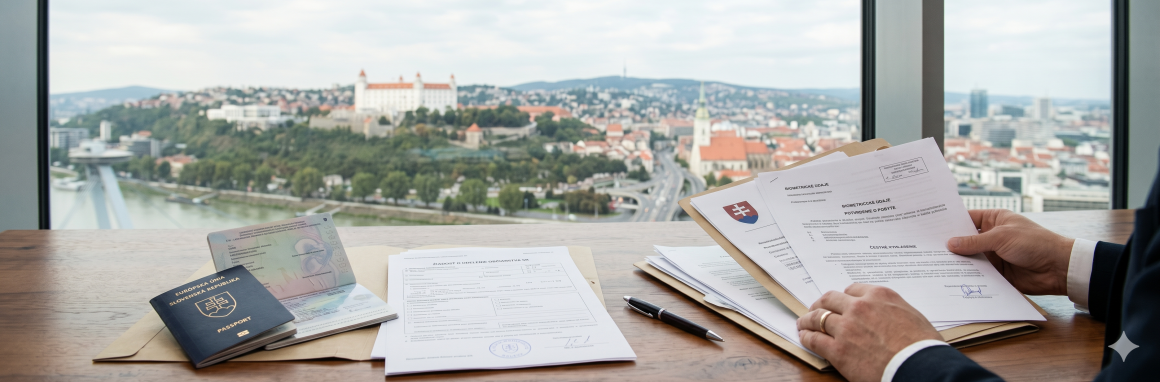
The Slovak government has approved a bill amending the rules on Slovak citizenship. At the time of writing, this refers to a bill already approved by the government that is currently undergoing the legislative process. According to the draft, the provisions on citizenship are set to take effect on July 15, 2026, provided that Parliament adopts the final version of the law.
For those interested in moving to Slovakia, legalizing their status, processing documents, and obtaining citizenship by descent, these changes are particularly important. On the one hand, some procedures may become significantly simpler, especially for applicants living outside Slovakia. On the other hand, the importance of well-prepared documents will increase, particularly in cases involving citizenship by descent.
In other words, the system may become more user-friendly in terms of procedure, but at the same time, it will place stricter requirements on the evidence. In this article, we’ll examine exactly what changes the bill proposes, who will benefit from them, what will change in the application process, and why it’s already important to carefully evaluate documents related to family lineage.
What exactly is changing in Slovakia's citizenship rules?
The most significant change concerns the descendants of former Czechoslovak citizens. But the bill does not stop there: it also changes the procedures for submitting applications through consulates, introduces more digital document processing, clarifies the rules for confirming citizenship, and reduces some of the unnecessary administrative steps following a positive decision.
The main change for the descendants of former Czechoslovak citizens
The residency requirement is proposed to be eliminate
The most significant change concerns those applying for Slovak citizenship as descendants of former Czechoslovak citizens. Under the current law, one of the major barriers was the requirement for a valid residence permit. The new bill changes this approach and allows citizenship to be granted without meeting the residency requirement to applicants who were not themselves Slovak citizens but who have at least one:
- parent;
- grandfather or grandmother;
- great-grandfather or great-grandmother;
- was a Czechoslovak citizen born in the Slovak Republic.
This is particularly important for applicants who live outside the country and do not plan to move to Slovakia in the near future. If Parliament passes the law, this group will no longer need to first resolve their residency status before applying for citizenship. The explanatory memorandum to the bill explicitly states that the overwhelming majority of such descendants do not live in Slovakia and, as a rule, will not live there in the future; therefore, it is no longer appropriate to tie the granting of citizenship to authorized residence.
Why is this important in practice?
For applicants, it means a shorter and more straightforward path to citizenship. For the service industry, it means growing interest from international clients who previously found the process too complicated, time-consuming, and costly - precisely because of the intermediate residency requirement.
The eligibility category is defined more precisely
It is not enough to simply be of “Slovak origin”
One of the key aspects of the bill is that it does not refer abstractly to “Slovak origin.” Instead, it introduces a more precise legal framework. To qualify for preferential treatment, one must prove two conditions simultaneously:
- The applicant's ancestor was a Czechoslovak citizen;
- that ancestor was born in Slovakia.
It is precisely this combination of criteria that forms the basis for reviewing the case.
To what degree of kinship does the rule apply?
The bill explicitly extends the eligible line of descent to great-grandparents. This means that the preferential category could potentially include applicants whose eligible ancestor is their:
- parent;
- grandfather or grandmother;
- great-grandfather or great-grandmother.
This is of great practical significance. On the one hand, a family legend, an ancestor’s nationality, or a Slovak surname do not, in and of themselves, substitute for documentary proof of citizenship. On the other hand, the official recognition of a lineage extending back to ancestors broadens the pool of potential applicants compared to how the boundaries of an acceptable lineage were previously understood.
Who is eligible for the preferential category?
| Criterion Element | What the Bill Requires | Why It Is Important |
| Degree of kinship | Parent, grandparent, great-grandparent | Expands the pool of potential applicants to include great-grandparents |
| Ancestor’s status | The ancestor must have been a Czechoslovak citizen | Family history or ancestry alone, without legal status, is not sufficient |
| Ancestor’s Place of Birth | The ancestor must have been born in Slovakia | This is a separate criterion that must be substantiated with documentation |
| Applicant’s Residence | No residency requirement applies to this category | This removes a key administrative barrier for applicants from abroad |
Documents are becoming a decisive factor
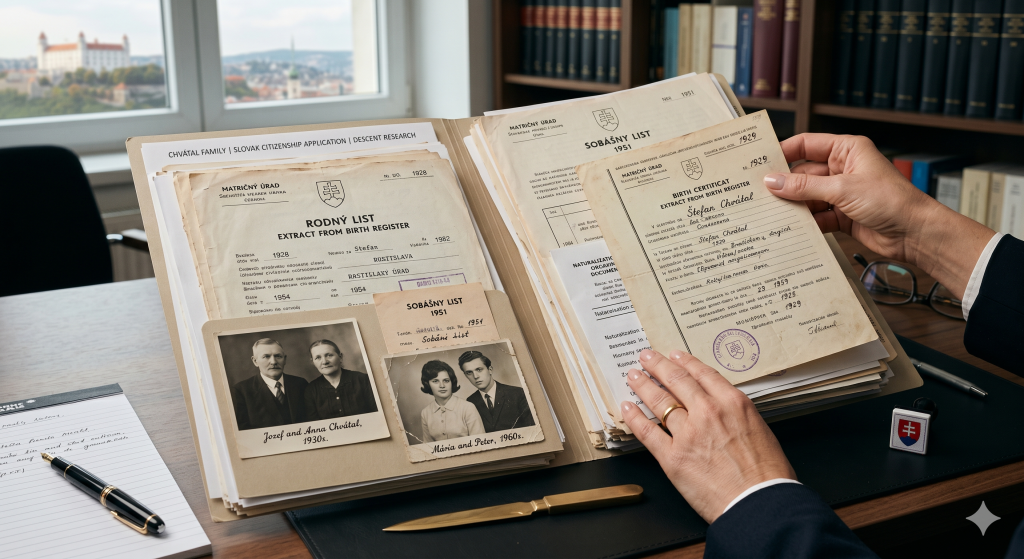
Although public descriptions of the reform sometimes present this as a tightening of requirements, the key idea is formulated in more specific legal terms in the bill itself: the list of documents required for such cases explicitly includes the obligation to submit a document or other record confirming that the applicant’s parent, grandparent, or great-grandparent was a Czechoslovak citizen and was born in Slovakia.
In practice, this means shifting the focus to the preparatory stage. Whereas some applicants previously viewed such cases as a process in which disputed issues could be clarified during the proceedings, following the adoption of the amendments, the quality of the evidence gathered in advance will be the decisive factor.
The following will be of particular importance:
- archival records;
- civil registry records;
- documents regarding an ancestor’s citizenship;
- proof of an ancestor’s place of birth.
In practice, this highlights the value of professional guidance even before the documents are filed. A thorough preliminary analysis helps identify weaknesses in the evidence, determine in advance which documents are missing, and develop a stronger case strategy.
For the applicant, this means that the success of the case will depend even more on the documents than on the overall logic of the family history. The process becomes clearer, with less uncertainty and a lower risk of rejection due to an inadequately prepared set of documents.
It will be more convenient to submit applications through consulates

Applications may be submitted electronically or by mail
The bill provides for an expansion of the methods for submitting applications related to the confirmation of citizenship. Individuals who are abroad will be able to submit an application for a Slovak citizenship certificate to a diplomatic mission or consulate:
- in person;
- electronically;
- by mail.
According to the explanatory note, a similar approach will be applied to applications for certification of citizenship.
Why is it useful?
This change has significant practical implications for applicants from abroad. Until now, many have had to spend time and money simply to initiate the formal part of the procedure. If the amendments are adopted, in-person visits during the early stages will become less mandatory, and the system itself will become more accessible to:
- diasporas;
- families with children;
- elderly applicants;
- people who live far from consulates.
If you're just assessing your chances, it's helpful to find out in advance who is eligible for Slovak citizenship by descent and what documents are required.
Internal document processing will become more digital
The project introduces electronic communication between consulates and the relevant authorities in Slovakia. If an application for a certificate of citizenship is submitted from abroad, the consulate will forward it to the relevant authority electronically. The issued document will also be returned to the consulate electronically.
By default, such a document will not be issued to the applicant in paper form. A paper copy will be issued only if the applicant specifically requests it when submitting the application.
For the applicant, this means a more technologically advanced and potentially more convenient system.
It will be possible to request proof of citizenship for a specific date
Another useful change concerns the confirmation of citizenship as of any date specified by the applicant. The explanatory note explicitly states that the option to apply for confirmation of Slovak citizenship as of any date specified by the applicant has been expanded.
This is particularly important in cases where citizenship needs to be confirmed not simply “as of today,” but as of a specific point in the past or for a specific legal purpose. This option may be useful, in particular:
- in inheritance matters;
- when recovering lost documents;
- when registering civil status records;
- when processing passport applications;
- in other situations where status as of a specific date is relevant.
A certificate of citizenship is valid for six months
The bill confirms that a certificate of citizenship issued under the procedure described will be valid for six months from the date of issuance.
At first glance, this may seem like a technical detail, but in practice, it affects the planning of next steps. Applicants who are simultaneously preparing:
- applying for a passport;
- obtaining an ID card;
- registering in a special database;
- other related procedures.
It will be necessary to schedule the timeline so that the document remains relevant until the entire chain of procedures is completed.
The act granting Slovak citizenship will temporarily be recognized as proof of citizenship
One of the most practical changes is that the act granting Slovak citizenship itself will be considered proof of citizenship for 90 days from the date of receipt.
Why is this important? Currently, a person who has received such a document cannot immediately proceed to the next administrative steps but must separately request a certificate of citizenship. The bill proposes eliminating this intermediate step. If the provision is adopted, it will be possible to move on to further procedures more quickly within 90 days, for example:
- the issuance of identification documents;
- registration at the place of residence;
- other related procedures.
For applicants, this means saving time. For companies, it means the opportunity to provide clients with a shorter and more straightforward support process after a positive decision.
Some powers are transferred to district authorities
The bill also changes the division of responsibilities among government agencies. In practice, this could affect processing times, the flow of documents, and the procedures for interacting with government agencies.
How the bill would affect applicants
The bill makes the system more user-friendly in several ways.
Main advantages for the applicant
- Descendants of former Czechoslovak citizens will no longer need to first establish residency status in order to apply for citizenship.
- The line of descent officially includes not only parents and grandparents, but also great-grandparents.
- Applying through consulates will become more convenient thanks to electronic and postal submission.
- Electronic document exchange between the consulate and the relevant authority in Slovakia may speed up administrative processing.
- It will be possible to request confirmation of citizenship as of a specific date.
- The certificate of citizenship may be used temporarily as proof of citizenship for 90 days.
- The six-month validity period of the certificate provides a clearer framework for planning next steps.
Checklist: What to check right now
If you want to apply for citizenship by descent:
- Check whether your family line includes a parent, grandparent, or great-grandparent who was a Czechoslovak citizen.
- Verify whether this ancestor was born specifically in Slovakia.
- Determine what documents can be used to confirm this.
- Prepare archival and official documents in advance; do not assume that any points of contention can be “clarified later.”
- If you live abroad, keep in mind that after the amendments are adopted, submitting your application through a consulate may become easier.
Conclusion
If Parliament passes the bill, from July 15, 2026, the Slovak citizenship system could become significantly more modern and user-friendly. For descendants of former Czechoslovak citizens, the process will be simpler thanks to the elimination of an unnecessary residency requirement. For applicants from abroad, it will be more accessible through electronic and mail-in submissions via consulates. For everyone going through the process, it will be clearer thanks to digital document exchange and the elimination of some intermediate steps.
The main conclusion is simple: the bill reduces administrative barriers but, at the same time, increases the importance of well-prepared documents. Therefore, it is especially important right now not only to understand whether you fall into a preferential category but also to assess the strength of your evidence in advance. The practical outcome once the new rules take effect will depend largely on this.
If you want to assess the prospects of your case in advance and prepare a strong evidentiary basis , the experts at Togetthere are ready to guide you through every step - from the initial review of documents and strategy development to filing your application and obtaining citizenship.